Posts

Rhino Horn Trade: A Very Pointed Bubble

Can you imagine a horn having more value than gold in the international black market? Well, I was as shook as you are when I found out! The Rhino horn trade is far more complex than it seems to be. Rhinoceros  poaching was banned in India in 1910. Yet Rhino poaching trends have been high and not so surprisingly the horn is the most sought after body part of Rhinos. Despite it being a punishable offence, these poachers who are generally skillful sharpshooters take the risk as the yields are beyond believable! A kilo of Rhino horn is pegged at around $100,000 in the international market with an average horn being around 1-3 kg. The price is perhaps more than that of Gold or Cocaine. Why? Let’s look at the demand. The ever increasing demand of Rhino horns has seen upto 30% rise in the past 13 years. This insane demand comes from Vietnam, and China, as it’s believed that Rhino horns have Cancer curing properties. This belief was strengthened by a rumour that swept Vietn...

THE BIG FAT INDIAN WEDDING IS PERHAPS TOO FAT FOR OUR ECONOMY

Weddings are a feast anywhere in the world. But in India, weddings are a full blown festival with vibrant colors, jolly faces and beautiful memories. The Big Fat Indian weddings are as magnanimous as the ones shown in bollywood. Technically similar to any other (usually) small ceremony, a key difference is the money spent on everything. People usually spend all of their savings just to make that one day, a big day for them. So when it comes to weddings, Indian parents don’t even do any kind of cost-benefit analysis and it’s more like a reflex where the moment their children decide to get married, they open this treasure trove of money and jewellery that they have been collecting/saving since the day their children were born. Indian cinema has been the protagonist in this community wide change of preferences for weddings that people have recently had. But now the question that arises is- Is it worth it for people to spend all their savings in one day? Why have people changed their pref...

Budget Series: Taxation

Image
Presenting the Budget 2018 the Finance minister said as government had made many positive changes in the personal income-tax rate applicable to individuals in the last three years. Therefore, govt do not propose to make any further change in the structure of the income tax rates for individuals. It has only increased 1% cess on personal income tax. Budget 2018 proposed a standard deduction of Rs40,000 in lieu of transport allowance and medical reimbursement, giving relief to the salaried people(a revenue sacrifice of Rs8,000 crore for govt).Some of the experts say that it is a very nominal for the salaried people as earlier  medical expense reimbursement of 15,000 per annum and transport allowance exemption of Rs1,600 per month was anyway leading to a total tax-free salary of Rs34,200. Also, Budget 2018 has reduced the corporate tax rate for companies with an annual turnover of up to Rs250 crore to 25%.This will benefit the the micro, small and medium enterprises (MSMEs)...

Budget Series : Finance and Banking

Image
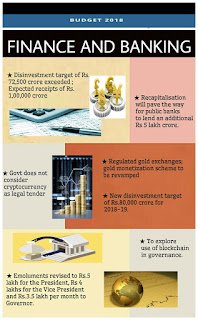
With no big bang announcements on the Budget day, the banking sector had to be satisfied with what they already have. In fact, were given a bigger task to provide incremental loans worth Rs 5 lakh crore in Fy19. The proposal to allow RRBs to raise market capital would enable these institutions to support credit flow to the rural sector. The proposals to review the refinancing norms for NBFCs(Non-Banking Financial Company) under MUDRA and receivable discounting by PSBs would improve credit supply to MSMEs and support the credit growth of banks and NBFCs. The increase in exempted interest income is unlikely to significantly improve deposit base, as the tax exemption is restricted to senior citizens who anyways prefer bank deposits. However, the proposal to provide insurance and pension benefits to the poor through Jan Dhan accounts can improve the deposit base of banks to some extent. The big expected announcement which didn’t come was the increase in foreign holding limit in priva...

Budget Series: Fiscal Management

Image
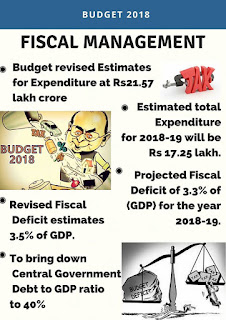
The Finance minister has set the fiscal deficit target for 2018-19 at 3.3% of the gross domestic product (GDP) against the earlier target of 3%.Most analysts say they had expected it to be 3.2%.The government also revised the deficit target for the year ending in March 2018 to 3.5% of GDP from the targeted 3.2%. Key recommendations of N.k singh Committee are accepted by finance minister to reduce debt-to- GDP ratio to 40% by 2024 to 2025. The debt-to-GDP ratio was 50.1 % in l ast year. Now government aims to reduce the ratio by 3.3% in 2018-19 , by 3.1% in 2019-2020 and 3% by 2020-21. In this budget Government has also introduced amendments to the present fiscal Responsibility and Budget Management Act. The government has increased its borrowing programme from Rs6.05 trillion to Rs6.06 trillion for the next fiscal year.The fiscal deficit target of 3.5% of GDP was achieved after cutting down capital expenditure by Rs36,000 crore in 2017-18. A shortfall of Rs50,000 crore on accoun...

Budget Series: Infrastructure

Image
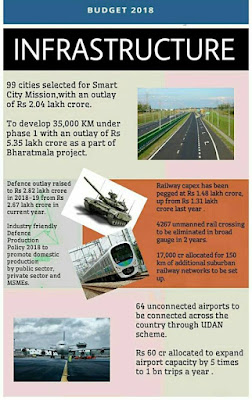
The total capital outlay for the infrastructure sector has been budgeted to increase by 20.8% to Rs 5.97 lakh crore in FY18-19. The infrastructure sector expects continued thrust from the government towards revival of investment cycle in the form of further increase in budgetary allocations towards infrastructure sector with focus on roads, railways and urban infrastructure. Apart from these core subsectors the special focus of this Budget 2018 has been on rural infrastructu re through development of rural roads, houses, sanitation, irrigation and water supply. With an aim to bring back the flagging revenues of the national transporter back on track, Arun Jaitley announced a capital expenditure allocation of Rs 1.48 crore for the railways. This includes redevelopment of 600 major railway stations and setting up of escalators and CCTVs and Wi-Fi facilities. This will help digitalization of Indian railways along with improvement on safety. Delays and accidents, the two main problem fa...

Budget Series : Education Sector

Image
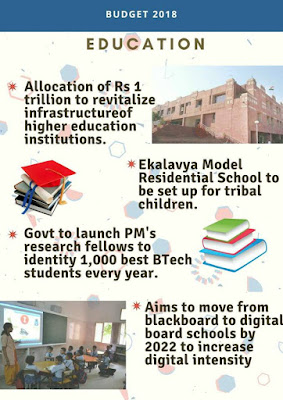
India’s higher education institutes need to gear themselves up towards addressing the new challenges presented by advancement ot technology and increase in automation systems. Technology can play a big role in taking quality education to masses. There should be no GST or income tax on education-technology companies which are delivering education through online mode. Ekalavya Model Residential School to be set up in every block with more than 50% ST population and at least 20, 000 tribal persons. The schools will also focus on providing training in sports and skill development. Introducing an updated and current edition of the National Education Policy would be a clear indication of the government’s commitment to the agenda of improving the education sector. The government must look at further improving access to education at all levels and rationalising taxes to make books, notebooks and educational material including those via e-learning education programs affordable fo...